You learn that ぺらぺら (pera-pera) means “fluently.” A week later, you recognize it in a flashcard but freeze when someone says, 日本語がぺらぺらですね. The word was in your memory, but it was never connected to a voice, a situation, or a sentence.
That is the central problem with Japanese mimetic words. They are often taught as decorative vocabulary—long lists of items such as “sparkling,” “heart pounding,” or “rolling around.” Native speakers, however, use them as compact sensory descriptions. To remember them, you need to study the sensation and the language pattern together.
This guide shows you how to study Japanese mimetic words as a system. You will learn how their sounds carry clues, how they fit into sentences, how to build useful memory cards, and how to practice them over seven days without trying to memorize hundreds at once.
What Japanese mimetic words actually describe
English onomatopoeia usually imitates a real sound: “buzz,” “splash,” or “bang.” Japanese goes much further. Its sound-symbolic vocabulary can represent a noise, a movement, a texture, a physical condition, or an emotion—even when the thing itself is silent.
You will often see five labels:
| Category | What it represents | Example | Core image |
|---|---|---|---|
| 擬声語 (giseigo) | Human and animal voices | ワンワン (wan-wan) | a dog barking |
| 擬音語 (giongo) | Sounds from objects or nature | ザーザー (zā-zā) | rain pouring down |
| 擬態語 (gitaigo) | States, textures, and appearances | キラキラ (kira-kira) | light sparkling |
| 擬容語 (giyōgo) | Movements and manners of action | うろうろ (uro-uro) | wandering without direction |
| 擬情語 (gijōgo) | Feelings and psychological states | わくわく (waku-waku) | excited anticipation |
Do not worry about perfectly classifying every word. Dictionaries and teaching materials sometimes group the categories differently. The useful distinction is simpler: does the word point to a sound, an observable state or action, or an inner feeling? That question gives your memory something concrete to attach to.
Why ordinary vocabulary study fails here
A one-to-one translation strips away most of the information. じろじろ (jiro-jiro) may be glossed as “staring,” but it carries the uncomfortable feeling of looking repeatedly and without restraint. しとしと (shito-shito) is not merely “rain”; it evokes gentle, steady rainfall. If both become a plain English definition, the contrast disappears.
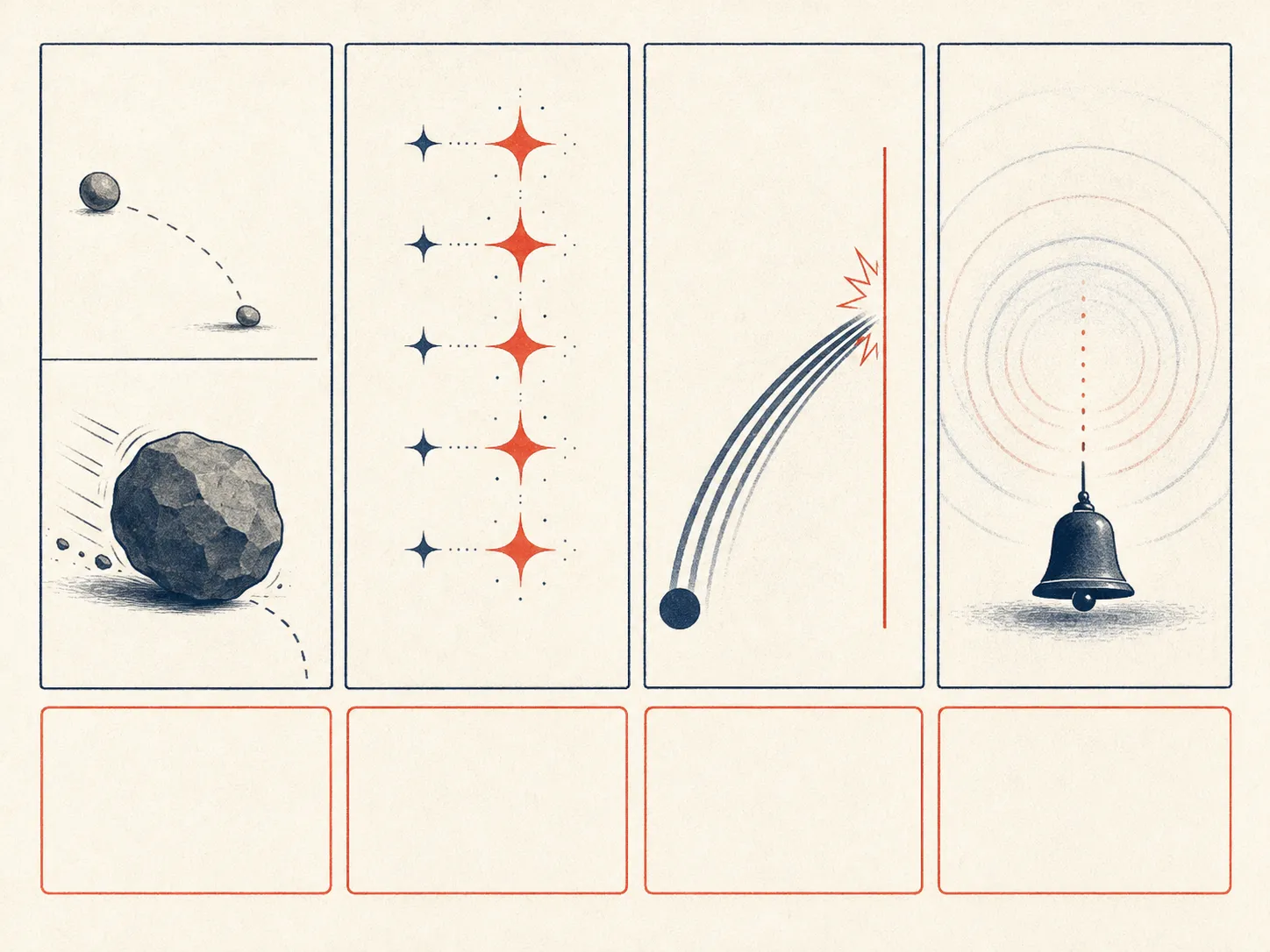
There is another trap: similar-looking forms can describe different intensity, duration, or movement. Kokugakuin University gives a useful contrast between ころころ (koro-koro) and ごろごろ (goro-goro). The unvoiced k suggests something lighter rolling, while the voiced g suggests something heavier. The repeated form indicates continuing movement.
This means a mimetic word is not just a vocabulary item. It is a small bundle containing sound, rhythm, intensity, duration, viewpoint, and grammar. Your study method should preserve that bundle.
Learn the sound patterns before the word list
Japanese sound symbolism is not a perfect code, but it gives you strong hints. Learning a few recurring contrasts makes unfamiliar words easier to infer and related words easier to separate.
Voiced consonants often feel heavier or stronger
Compare ころころ with ごろごろ. Voicing changes k to g, and the image becomes heavier or rougher. Similar contrasts appear in many sound-symbolic families. Treat this as a tendency rather than a rule: voiced consonants often suggest greater force, size, weight, or intensity.
Repetition suggests continuation
Forms such as キラキラ (kira-kira) and どきどき (doki-doki) repeat because the sparkling or pounding continues. When you hear an ABAB rhythm, first imagine a repeated or ongoing event. This is more useful than immediately reaching for an English translation.
A small っ creates an abrupt stop
A form ending in っ, often followed by と, can feel sudden or sharply bounded. The sound stops in your throat, and the event feels as if it does too. Say the word aloud and exaggerate the stop; your mouth is teaching you the meaning.
An ending in り feels slower or more settled
Many り forms convey a deliberate, soft, or completed manner. ゆっくり (yukkuri), for example, describes doing something slowly and without rushing. Do not memorize “り = slow” as a formula. Notice that the ending often gives the word a more measured contour than a clipped っ.
An ending in ん can leave resonance
The nasal ん can suggest lingering sound, bounce, or continuation. Again, it is a clue rather than a definition. The goal is to train your ear to ask, “What does this shape make me feel?”
Build scene cards, not translation cards
The most effective card has enough context to reconstruct the sensation. Use one card for one meaning in one situation.
Here is a practical template:
- Front: a short audio or video clip, plus one sentence with the target word hidden.
- Back: the complete Japanese sentence, a natural English meaning, and one image or sensory note.
- Sound clue: one short observation such as “repetition = ongoing sparkle.”
- Grammar frame: the particle or verb pattern used in that sentence.
- Source: the show, conversation, article, or book where you found it.
For どきどき, a weak card says:
どきどき = nervous / heart pounding
A useful card says:
面接の前は、いつもどきどきする。
I always get nervous before an interview.
Scene: waiting outside the interview room, heartbeat repeating.
Pattern: どきどきする.
The second card gives your brain several retrieval paths. You can recall the waiting room, the heartbeat rhythm, the sentence, or the する construction. You are no longer betting everything on an English gloss.
Study the grammar that travels with each word
Mimetic words become usable only when you know how they attach to the sentence. Instead of collecting every possible construction, save the pattern you actually encountered.
Common frames include:
- 〜する for a feeling, state, or action: どきどきする.
- 〜と + verb when the expression modifies an action or sound: ドアがバタンと閉まった.
- 〜に + verb for the resulting state: 部屋をぴかぴかにする.
- Direct adverbial use with a verb: 雨がしとしと降っている.
Say the whole chunk aloud. わくわく is less useful than わくわくする, and じっと is easier to deploy when learned inside じっと見る or じっと待つ. Fluent speech is built from retrievable chunks, not loose dictionary entries.
Organize by contrast, not by alphabet
Alphabetical lists hide relationships. A better notebook groups words around one sensory dimension:
- Light versus heavy: ころころ / ごろごろ
- Gentle versus forceful rain: しとしと / ざあざあ
- Looking: ちらっと / じっと / じろじろ
- Emotional arousal: わくわく / どきどき / いらいら
- Surface and texture: さらさら / すべすべ / べたべた
Add only two or three items to a contrast set. Write one sentence explaining the boundary between them. If you cannot explain when you would choose one over the other, you do not know the pair yet.

Use a seven-day learning loop
Start with five words, not fifty. Choose items you have met in real content or expect to use soon.
Day 1: Notice
Collect five examples from a drama, anime episode, podcast transcript, graded reader, or conversation. Keep the original sentence and timestamp. Do not make cards yet. Your only job is to notice what was happening when the word appeared.
Day 2: Decode
Look up each item in more than one dictionary or example source. Identify the central sensation, the grammar frame, and one possible sound clue. Check whether the word has multiple meanings; keep only the meaning used in your original scene.
Day 3: Rebuild
Create your five scene cards. On review, play the clip or read the sentence with the word hidden and try to supply it. This tests recall from context rather than recognition from a list.
Day 4: Contrast
Find one neighbor for each difficult word. Ask what changes: intensity, duration, repetition, emotional tone, or politeness. You do not need to memorize every neighbor. The comparison exists to sharpen the boundary.
Day 5: Imitate
Shadow the original sentence three times. Match rhythm and emphasis, especially repeated syllables and abrupt endings. Then change one detail while preserving the grammar frame: swap “interview” for “exam,” or “rain” for “snow.”
Day 6: Produce
Describe five moments from your day using the target expressions. If a sentence feels forced, search for native examples before keeping it. Production should confirm a pattern, not invent one.
Day 7: Retrieve
Review without English prompts. Look at the image, hear the audio, or recall the scene and say the full Japanese chunk. Keep successful cards in spaced repetition. Rewrite or discard cards that still depend on translation.

Common mistakes that slow learners down
Memorizing rare words because they look fun
Frequency and personal relevance beat novelty. Start with expressions you repeatedly hear in your own media diet. A common word learned from three scenes is more valuable than thirty exotic entries copied from a list.
Treating the English gloss as an exact match
Translations are navigation aids, not definitions. Record the scene, intensity, and speaker attitude. When two Japanese items share the same English gloss, contrast native examples instead of adding more English synonyms.
Ignoring pronunciation
These words are sound symbolic. Silently reading them throws away part of the memory signal. Listen, repeat, and preserve rhythm. If audio is unavailable, use a reliable Japanese dictionary with recordings before making the card.
Studying categories instead of usage
The five labels help you understand the system, but identifying gitaigo on a quiz will not help you speak. Spend most of your time on sentence chunks, contrasts, and retrieval.
Forcing a new word into every conversation
Mimetic vocabulary carries tone. Some expressions sound casual, vivid, childish, comic, literary, or situation-specific. Observe who uses the word and where before making it active vocabulary.
Frequently asked questions
Should beginners study Japanese mimetic words?
Yes, selectively. Beginners benefit from high-frequency items tied to familiar verbs and daily situations, such as ゆっくり, わくわくする, or ぴかぴか. Avoid large specialist lists until you can understand simple example sentences.
Are mimetic words usually written in hiragana or katakana?
You will see both. Katakana often adds visual emphasis or a harder impression, while hiragana can feel softer, but usage is flexible. Learn the spelling used in your source and expect to recognize the other form.
How many should I learn at one time?
Five per weekly cycle is enough when each item includes audio, context, grammar, and retrieval practice. If reviews remain easy, increase gradually. Card quality matters more than list size.
Do I need to memorize all five categories?
No. Learn what the categories reveal: Japanese sound symbolism covers far more than audible noises. After that, prioritize meaning boundaries and sentence behavior.
Can anime and manga be good sources?
Yes, especially for noticing vivid expressions, but check register and real-world usage. Confirm an item with a dictionary, corpus, conversation partner, or examples from several sources before using it freely.
Your next study session
Choose one scene you watched or heard this week. Extract no more than five mimetic expressions. For each one, keep the clip, identify the sensation, save the grammar frame, and say the complete sentence aloud. That small loop trains the skill a giant vocabulary list cannot: hearing a sound shape and immediately recovering a living Japanese scene.
References and further reading
- Japanese Mimetic Words — Exploring the Sounds of Nippon — 90 Day Japanese
- How should we learn onomatopoeic and mimetic words? — Kokugakuin University
- Japanese Onomatopoeia: The Guide — Tofugu