How to Say Happy Birthday in Korean (Without Sounding Awkward)
The safest way to say happy birthday in Korean is:
생일 축하해요!
Saengil chukahaeyo!
Happy birthday!
This polite phrase sounds natural with a colleague, a classmate you do not know well, a friend who is slightly older, or almost anyone when you are unsure how casual to be.
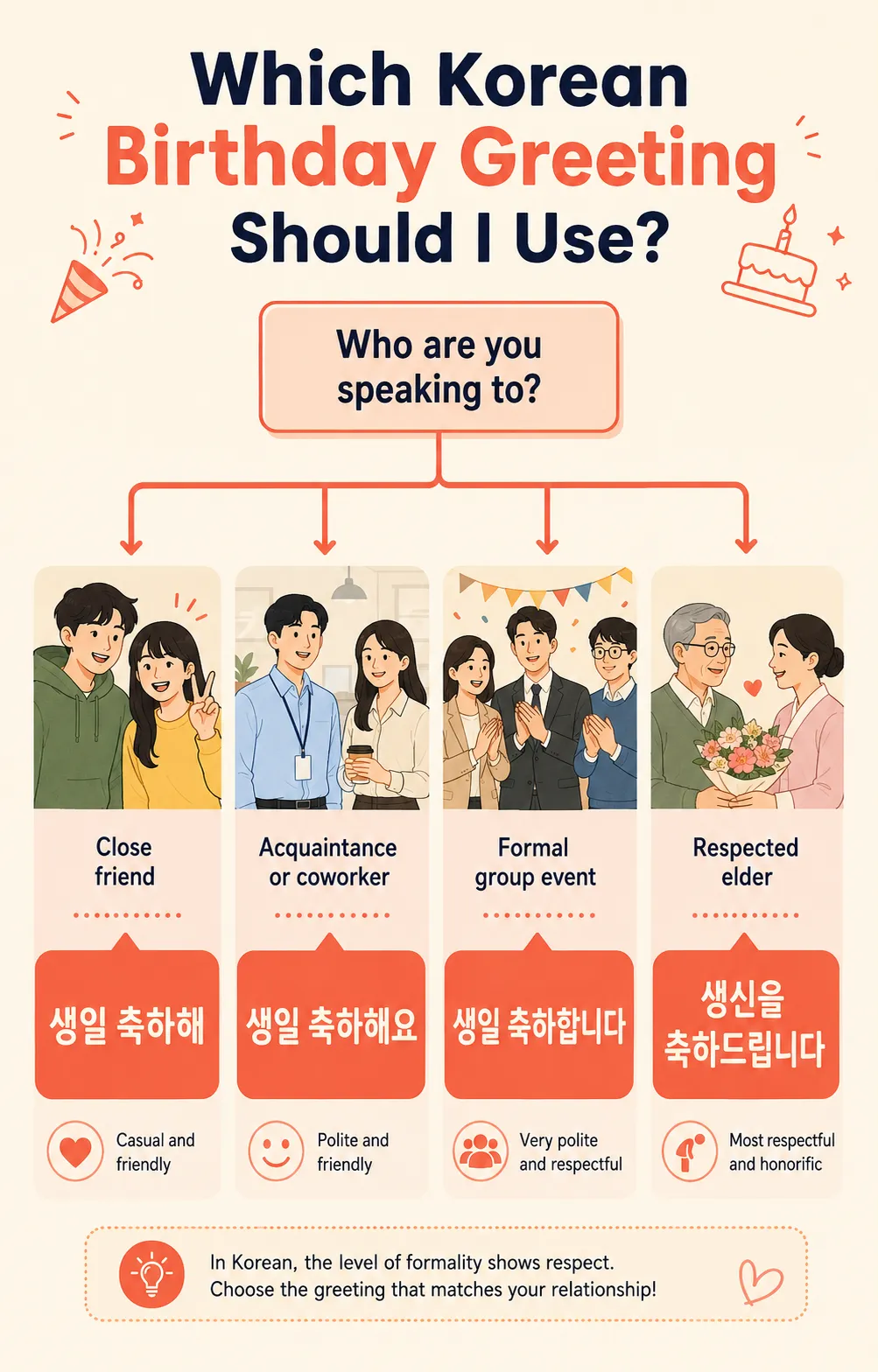
But Korean does not have one birthday greeting that fits every relationship. The wording changes depending on the other person's age, status, and closeness to you. You might say 생일 축하해 to your best friend, 생일 축하합니다 during a formal celebration, or 생신을 축하드립니다 to a respected elder.
This guide explains which version to choose, how to pronounce it, what to write in a birthday message, and what to expect at a Korean birthday celebration.
Quick Answer: Four Ways to Say Happy Birthday in Korean
| Speech level | Korean | Romanization | Best used with |
|---|---|---|---|
| Casual | 생일 축하해! | saengil chukahae | Close friends, partners, siblings, and younger people |
| Polite | 생일 축하해요! | saengil chukahaeyo | Coworkers, acquaintances, and most everyday situations |
| Formal | 생일 축하합니다! | saengil chukahamnida | Announcements, public celebrations, and formal settings |
| Honorific | 생신을 축하드립니다! | saengsineul chukadeurimnida | Grandparents, elderly relatives, and highly respected elders |
If you memorize only one expression, choose 생일 축하해요. It is friendly without being overly familiar.
What Does 생일 축하해요 Mean?
The standard phrase is built from two parts:
- 생일 (saengil) means “birthday.”
- 축하해요 (chukahaeyo) means “congratulations” or, more literally, “I congratulate you.”
Korean speakers normally omit the subject and object when the context is obvious. That is why the natural phrase is simply 생일 축하해요, rather than a word-for-word translation of “I wish you a happy birthday.”
You may also see 생일을 축하해요, with the object particle 을 attached to 생일. It is grammatically complete, but the shorter 생일 축하해요 is extremely common in speech, messages, cards, and cake decorations.
A simple pronunciation guide
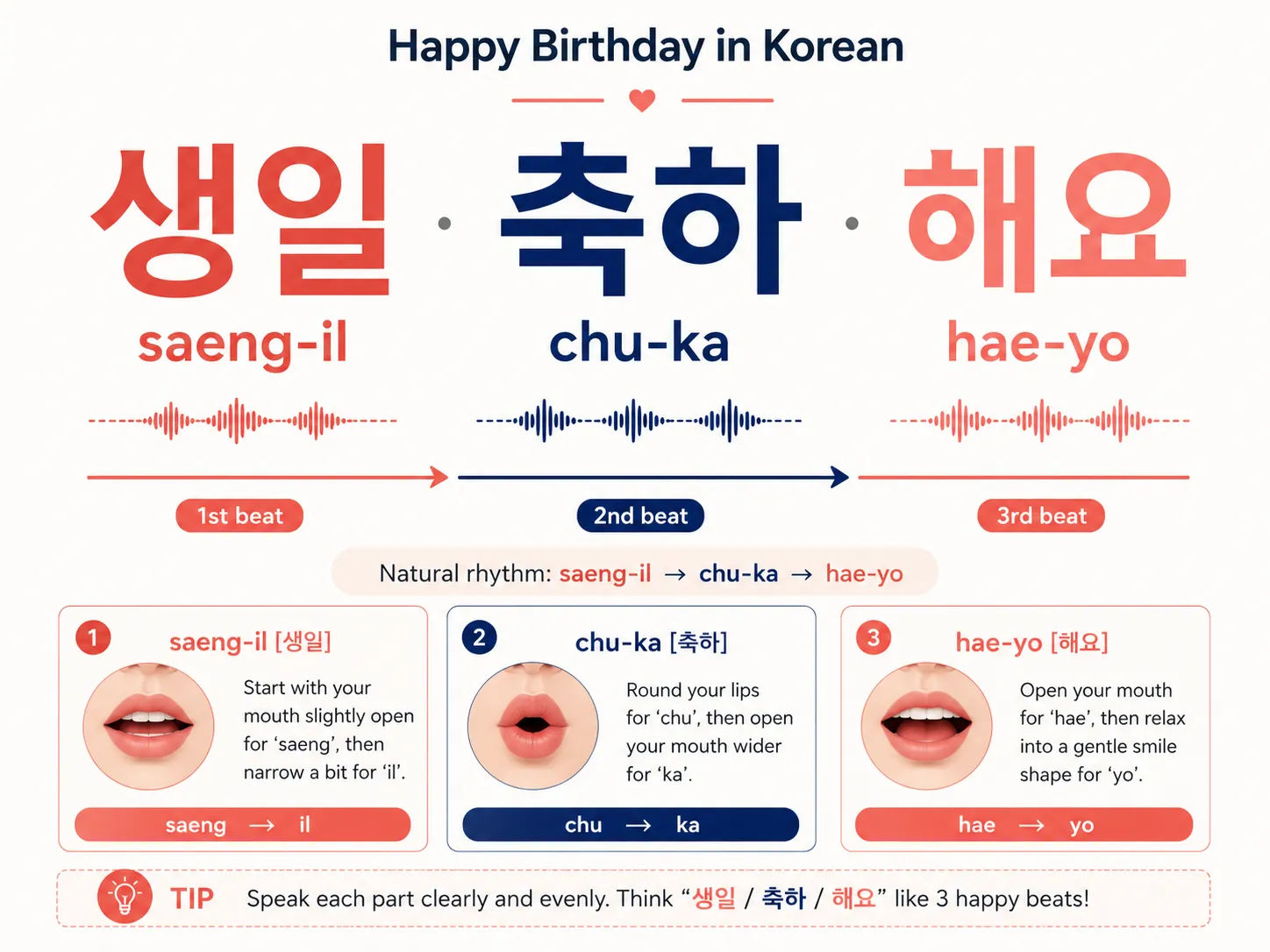
Say it in three rhythmic parts:
생일 / 축하 / 해요
saeng-il / chu-ka / hae-yo
In natural speech, 축하 is pronounced closer to 추카 (chuka) because the consonants blend together. Romanization is only an approximation, so use it as a temporary guide and pay attention to the Hangul spelling.
Casual: 생일 축하해
Use 생일 축하해! (saengil chukahae) with people you are genuinely close to when 반말 (banmal, casual speech) is already normal between you.
Good situations include:
- A close friend of the same age
- Your boyfriend, girlfriend, or spouse
- A younger sibling or cousin
- A child
- A close online friend when both of you already speak casually
The difference between 축하해요 and 축하해 is the polite ending 요. Removing it makes the sentence intimate and casual. That warmth is appropriate between close friends, but it can sound disrespectful if you use it suddenly with an older person, a professor, or a manager.
Natural casual birthday messages
생일 축하해! 오늘 신나게 보내!
Saengil chukahae! Oneul sinnage bonae!
Happy birthday! Have a fun day today!
생일 진심으로 축하해. 항상 행복하자!
Saengil jinsimeuro chukahae. Hangsang haengbokhaja!
Happy birthday from the bottom of my heart. Let's always be happy!
태어나줘서 고마워. 생일 축하해!
Taeeonajwoseo gomawo. Saengil chukahae!
Thank you for being born. Happy birthday!
That last message is affectionate and emotionally strong. It is popular between partners, very close friends, and fans writing warmly to an artist, but it would be too intimate for an ordinary coworker.
Polite: 생일 축하해요
생일 축하해요! is the best all-purpose answer for everyday life. It uses the polite 해요체 speech style: respectful enough for social distance, yet warmer and less ceremonial than formal 합니다체.
Use it for:
- A colleague you know reasonably well
- A classmate or neighbor
- A friend who is older than you when you still use polite speech
- A Korean host, teacher, or acquaintance in a friendly setting
- Someone whose preferred speech level you do not yet know
You can make the message more personal without changing its politeness:
생일 축하해요! 좋은 하루 보내세요.
Saengil chukahaeyo! Joeun haru bonaeseyo.
Happy birthday! Have a wonderful day.
생일 진심으로 축하해요. 소원이 모두 이루어지길 바라요!
Saengil jinsimeuro chukahaeyo. Sowoni modu irueojigil barayo!
Wishing you a very happy birthday. I hope all your wishes come true!
올해도 건강하고 행복하세요!
Olhaedo geonganghago haengbokhaseyo!
Please stay healthy and happy this year too!
Formal: 생일 축하합니다
생일 축하합니다! (saengil chukahamnida) uses the formal polite ending -ㅂ니다 / -습니다. It is common in the Korean birthday song and sounds appropriate in speeches, workplace announcements, group events, and written greetings from an organization.
It is not necessarily “more respectful” in every situation; it is more formal in tone. Saying it to a close friend is grammatically fine, but it may sound ceremonious or playfully stiff unless you are singing.
Example:
생일을 진심으로 축하합니다. 뜻깊은 하루 보내시길 바랍니다.
Saengireul jinsimeuro chukahamnida. Tteutgipeun haru bonaesigil baramnida.
We sincerely wish you a happy birthday. We hope you have a meaningful day.
This version works well in a company card, a public post, or a message to someone you know mainly through a professional context.
Honorific: 생신을 축하드립니다
For a grandparent or a significantly older and respected person, say:
생신을 축하드립니다.
Saengsineul chukadeurimnida.
I respectfully wish you a happy birthday.
Two honorific choices create the respectful tone:
- 생신 (saengsin) is the honorific word for an elder's birthday.
- 드리다 (deurida) is the humble form of “to give,” used here to present congratulations respectfully.
You will also hear 생신 축하드려요 (saengsin chukadeuryeoyo). It is respectful but warmer and more conversational than 생신을 축하드립니다.
A respectful message for a parent or grandparent
할머니, 생신을 진심으로 축하드려요. 항상 건강하시고 오래오래 행복하세요.
Halmeoni, saengsineul jinsimeuro chukadeuryeoyo. Hangsang geonganghasigo oraeorae haengbokhaseyo.
Grandma, I sincerely wish you a happy birthday. Please stay healthy and happy for many years.
Not every older Korean expects 생신. Adult friends only a few years apart may still use 생일, especially if their relationship is close. Think in terms of generation, relationship, and the speech style you already use—not age alone.
How to Sing Happy Birthday in Korean
The Korean birthday song uses the same melody as the English-language “Happy Birthday to You,” so you only need to learn the lyrics:
생일 축하합니다
생일 축하합니다
사랑하는 [name] 씨
생일 축하합니다
Romanization:
Saengil chukahamnida
Saengil chukahamnida
Saranghaneun [name]-ssi
Saengil chukahamnida
Meaning:
Happy birthday to you
Happy birthday to you
Dear [name]
Happy birthday to you
Should you add 씨 after the person's name?
씨 (ssi) is a polite name suffix, but real birthday groups adapt the third line to the relationship. Friends may sing only the person's name, a family may use a title such as 엄마 (Mom), and fans may use a stage name. Do not attach 씨 mechanically to every name; match what the group normally calls the person.
Also remember that Korean names are usually not stretched or altered to fit English pronunciation. Listen to the group once, then follow their rhythm.
Short Korean Birthday Wishes for Texts and Social Media
Korean messages often combine the main greeting with a wish for health, happiness, or a good day.
| Korean message | Romanization | Natural English meaning |
|---|---|---|
| 생축! | saengchuk! | HBD! / Happy b-day! |
| 행복한 생일 보내! | haengbokhan saengil bonae! | Have a happy birthday! |
| 오늘은 네가 주인공이야! | oneureun nega juingongiya! | You're the star today! |
| 소원 꼭 이루어지길! | sowon kkok irueojigil! | I hope your wish comes true! |
| 늘 건강하고 행복하세요. | neul geonganghago haengbokhaseyo. | Please always be healthy and happy. |
| 좋은 일만 가득하길 바라요. | joeun ilman gadeukagil barayo. | I hope your life is filled with good things. |
생축 is a shortened form of 생일 축하. It is perfect for a casual group chat, caption, or comment, but too abbreviated for an elder or a formal card.
Birthday message for a Korean friend
지민아, 생일 진짜 축하해! 맛있는 거 많이 먹고 오늘 하루 행복하게 보내!
Jimin-a, saengil jinjja chukahae! Masinneun geo mani meokgo oneul haru haengbokhage bonae!
Jimin, happy birthday! Eat lots of delicious food and have a wonderful day!
The vocative ending -아 / -야 is casual and depends on the final sound of the name. Use it only if you already address that person casually.
Birthday message for a coworker
생일 축하해요! 오늘 즐거운 시간 보내시고, 멋진 한 해 되세요.
Saengil chukahaeyo! Oneul jeulgeoun sigan bonaesigo, meotjin han hae doeseyo.
Happy birthday! Have a lovely time today, and may the year ahead be wonderful.
Birthday message for a K-pop idol
생일 진심으로 축하해요! 언제나 좋은 음악과 에너지를 줘서 고마워요. 늘 건강하고 행복하세요!
Saengil jinsimeuro chukahaeyo! Eonjena joeun eumakgwa eneojireul jwoseo gomawoyo. Neul geonganghago haengbokhaseyo!
Happy birthday from the bottom of my heart! Thank you for always giving us great music and energy. Please stay healthy and happy!
This message is warm while preserving polite speech, making it a safer choice for a public fan message than casual 축하해.
Korean Birthday Culture: More Than Cake and Candles
Learning the phrase is useful, but understanding the customs around it will make your message feel more informed.
미역국: Birthday seaweed soup
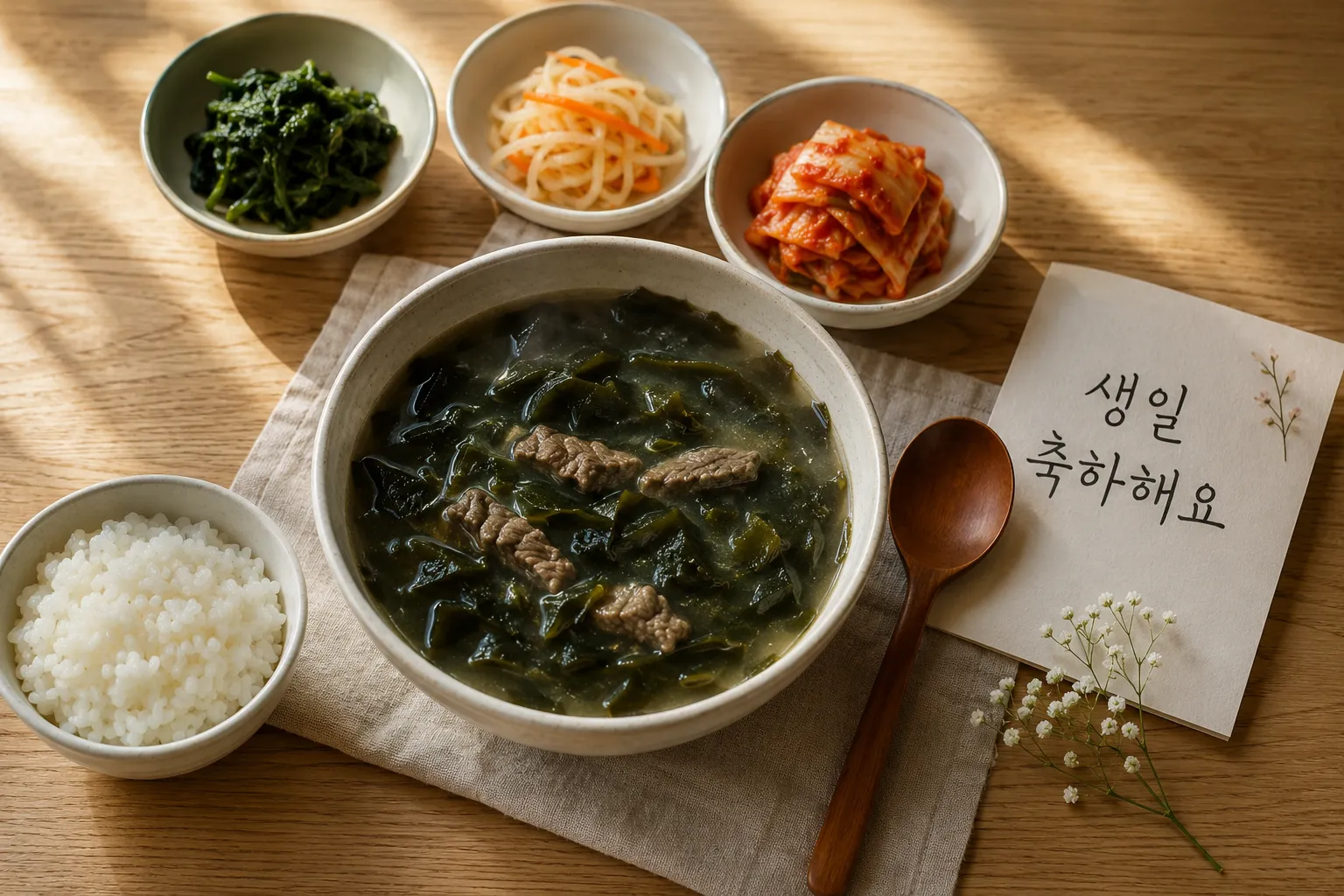
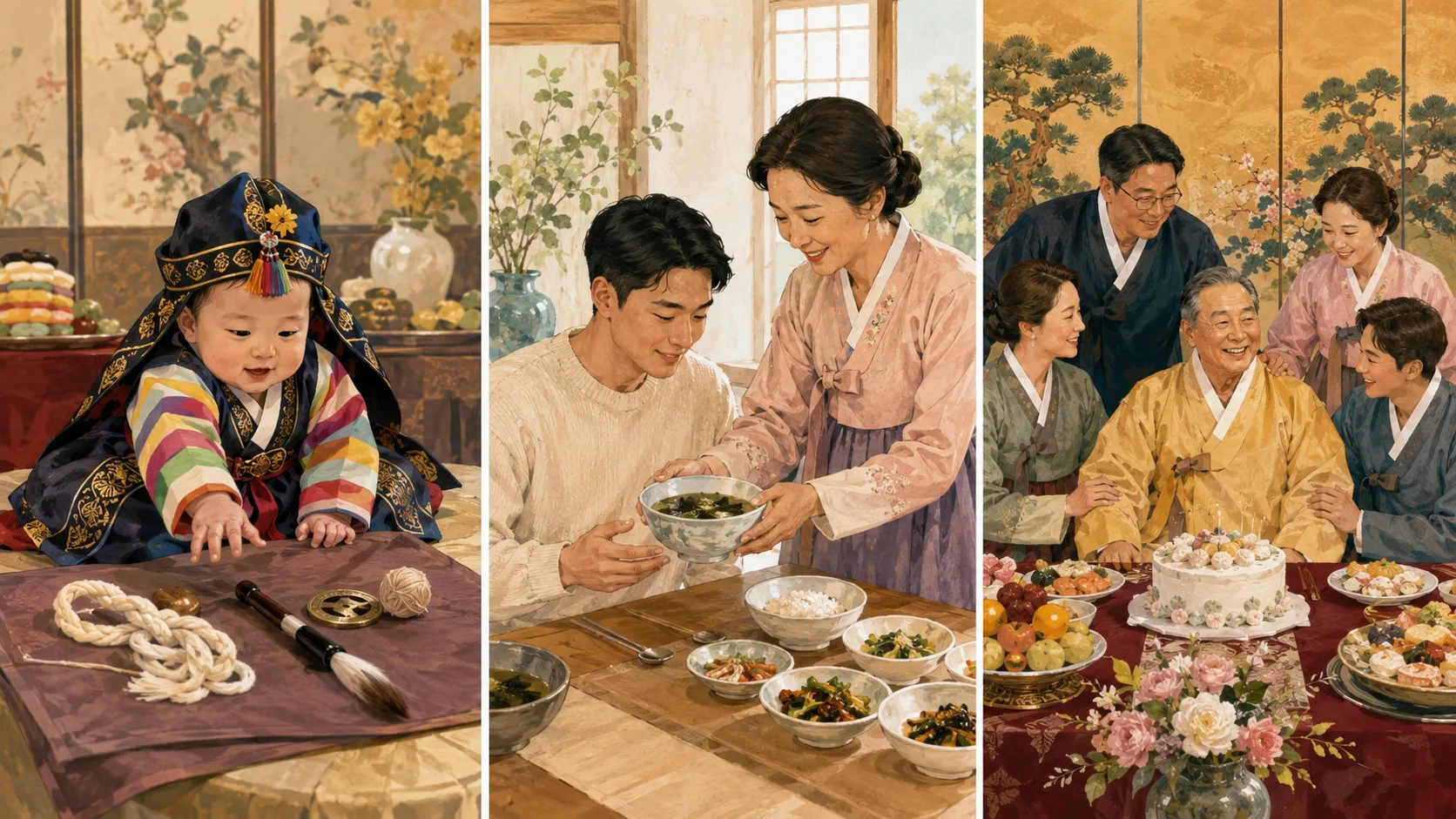
Many Koreans eat 미역국 (miyeokguk), seaweed soup, on their birthday. Seaweed soup is traditionally eaten by mothers after childbirth, so the birthday bowl also carries a connection to birth, maternal care, health, and gratitude.
Families prepare it in different ways, often with beef or seafood. Asking 미역국 먹었어요? (Miyeokguk meogeosseoyo? — “Did you eat seaweed soup?”) can be a friendly, culturally specific birthday question.
돌잔치: A baby's first birthday
A baby's first birthday celebration is called 돌잔치 (doljanchi). A well-known part of the event is 돌잡이 (doljabi), in which the baby chooses from symbolic objects. Traditional items may represent long life, scholarship, or prosperity; modern families sometimes add objects linked to careers or personal interests.
The ceremony reflects the historical importance of a child reaching the first-year milestone. Today it is also a joyful gathering for family photos, food, gifts, and wishes for the child's future.
환갑 and milestone birthdays
환갑 (hwangap) traditionally marks the completion of the 60-year cycle in the sexagenary calendar. It has long been treated as an important family milestone. Modern celebrations vary widely: some families hold a banquet, while others prefer a trip or a quiet meal.
South Korea adopted the international age-counting system for most legal and administrative purposes in 2023. However, age and hierarchy still influence everyday language, so choosing the correct speech level remains important even as official age calculation has changed.
Common Mistakes to Avoid
1. Using casual speech with an elder
생일 축하해 can sound rude when the relationship calls for polite or honorific speech. If you are uncertain, move up to 생일 축하해요. For a grandparent or a respected older relative, use 생신 축하드려요 or 생신을 축하드립니다.
2. Assuming formal and honorific mean the same thing
생일 축하합니다 is formal in sentence style, but it still uses the ordinary noun 생일. 생신을 축하드립니다 adds honorific vocabulary and humble speech for the recipient. The second phrase shows a different kind of respect, not merely a stiffer verb ending.
3. Depending on romanization for too long
You may encounter spellings such as chukahaeyo, chukhahaeyo, or chuka haeyo. They all attempt to represent 축하해요. Hangul is the stable source; romanization varies and cannot capture every sound naturally.
4. Translating an English card word for word
Natural Korean messages are often shorter and relationship-focused. A simple 생일 축하해요! 항상 건강하고 행복하세요 sounds better than a long sentence built with English grammar.
5. Choosing speech level from age alone
Age matters, but it is not the only factor. Workplace roles, family relationships, mutual agreement, and emotional closeness all affect Korean speech. Follow the level you normally use with that person, then make the birthday wording fit it.
Frequently Asked Questions
What is the most common way to say happy birthday in Korean?
The most broadly useful phrase is 생일 축하해요 (saengil chukahaeyo). It is polite, friendly, and natural in most everyday situations.
How do you say happy birthday in Korean informally?
Say 생일 축하해 (saengil chukahae) to a close friend, partner, sibling, child, or younger person when casual speech is already appropriate.
How do you say happy birthday to an older person in Korean?
For a respected elder, use 생신을 축하드립니다 (saengsineul chukadeurimnida) or the warmer polite form 생신 축하드려요 (saengsin chukadeuryeoyo).
What is the difference between 생일 and 생신?
Both mean “birthday,” but 생일 is the ordinary word, while 생신 is an honorific noun used for an older or highly respected person's birthday.
Can I write 생일 축하 without a verb ending?
Yes. 생일 축하! is a short, casual written greeting. 생축! is even more abbreviated. Use the full polite phrase on a card or whenever respect matters.
How do I say “Happy birthday to me” in Korean?
For a playful caption, Koreans may write 내 생일 축하해! (Nae saengil chukahae!), literally “Celebrate my birthday!” A more natural social post often simply says 오늘은 내 생일! (Oneureun nae saengil! — “Today is my birthday!”).
Is the Korean happy birthday song different from the English one?
The lyrics are Korean, but the melody is the familiar “Happy Birthday to You” tune. The third line usually includes the birthday person's name or family title.
The One-Minute Rule to Remember
When choosing a Korean birthday greeting, ask one question: How do I normally speak to this person?
- Casual relationship: 생일 축하해
- Polite everyday relationship: 생일 축하해요
- Formal public setting: 생일 축하합니다
- Respected elder: 생신을 축하드립니다
The grammar matters, but the relationship matters more. Choose the speech level that fits the person, add one sincere wish, and your birthday message will sound far more natural than a literal translation ever could.