How to Tell Time in Japanese: Hours, Minutes, and Real Conversations
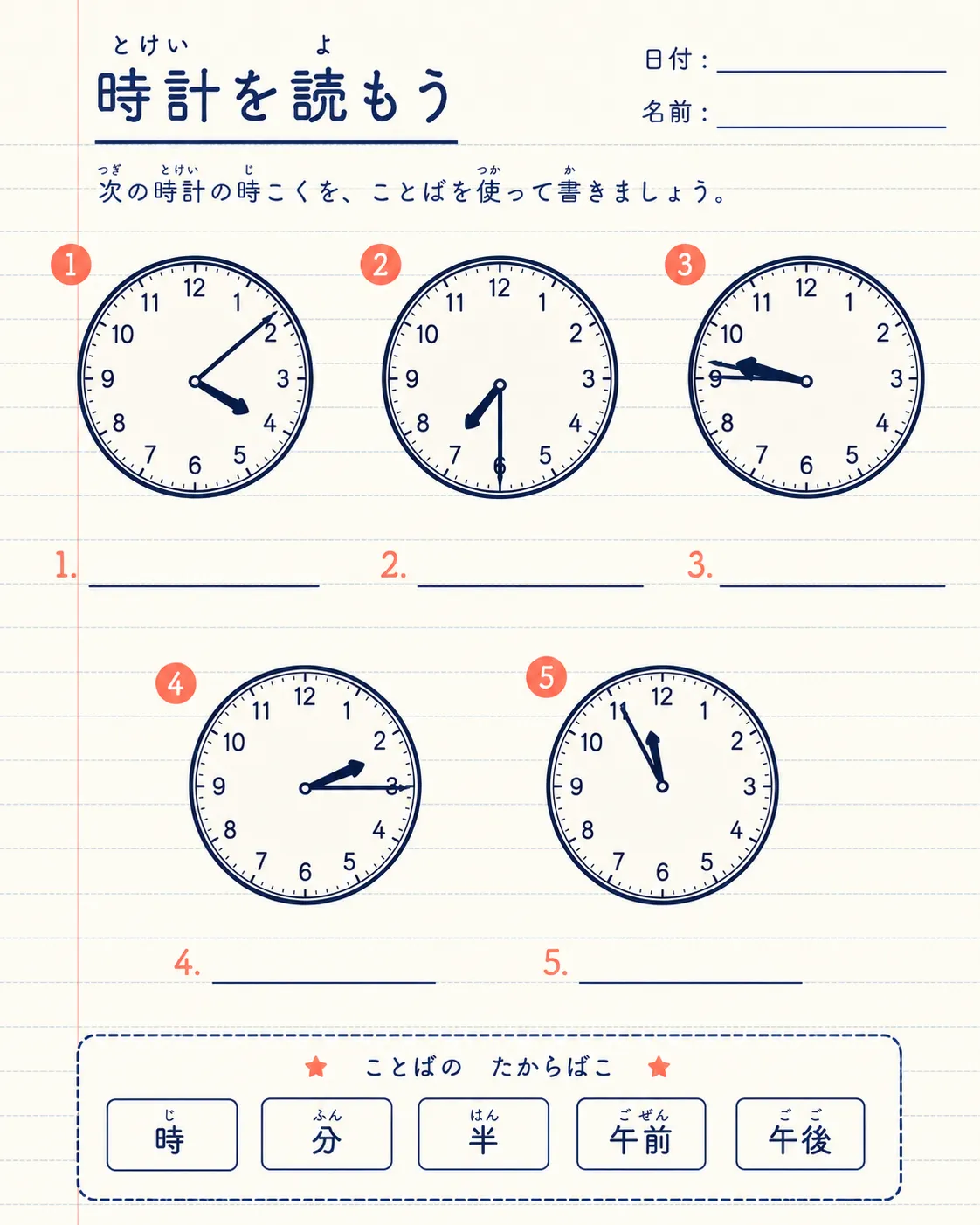
To tell time in Japanese language, put the hour before 時 (じ, ji) and the minutes before 分 (ふん/ぷん, fun/pun):
[hour] 時 + [minutes] 分
For example, 3:15 is:
三時十五分
さんじ じゅうごふん
sanji jūgofun
The formula is simple. The challenge is pronunciation: 4:00 is よじ, not よんじ; 9:00 is くじ, not きゅうじ; and “one minute” becomes いっぷん rather than いちふん.
This guide turns those exceptions into a usable system. By the end, you will be able to read a timetable, ask when a train leaves, make an appointment, talk about duration, and understand why 三時 and 三時間 do not mean the same thing.
The Quick Formula for Telling Time in Japanese
Japanese normally reads a clock from large unit to small unit:
hour + 時 → minute + 分 → second + 秒
| Clock time | Japanese | Reading |
|---|---|---|
| 2:00 | 二時 | にじ — niji |
| 4:10 | 四時十分 | よじ じゅっぷん — yoji juppun |
| 7:25 | 七時二十五分 | しちじ にじゅうごふん — shichiji nijūgofun |
| 9:30 | 九時半 | くじはん — kuji han |
| 11:48 | 十一時四十八分 | じゅういちじ よんじゅうはっぷん — jūichiji yonjūhappun |
You do not need words equivalent to English “past” for ordinary clock readings. Japanese simply says the hour followed by the exact number of minutes.
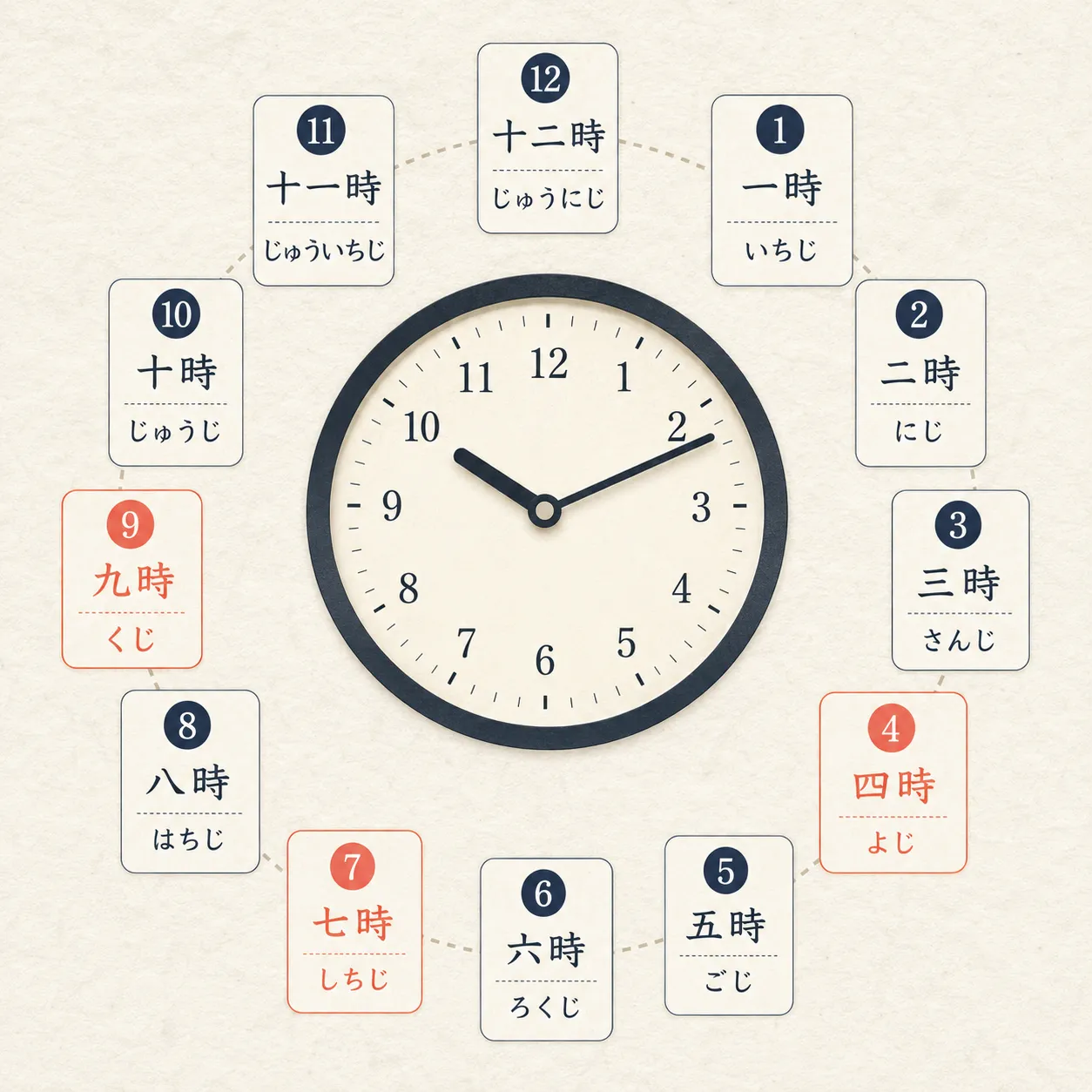
How to Say the Hours: 時 (じ)
Add 時 (じ) to a number to make an hour on the clock.
| Time | Kanji | Hiragana | Romanization |
|---|---|---|---|
| 1:00 | 一時 | いちじ | ichiji |
| 2:00 | 二時 | にじ | niji |
| 3:00 | 三時 | さんじ | sanji |
| 4:00 | 四時 | よじ | yoji |
| 5:00 | 五時 | ごじ | goji |
| 6:00 | 六時 | ろくじ | rokuji |
| 7:00 | 七時 | しちじ | shichiji |
| 8:00 | 八時 | はちじ | hachiji |
| 9:00 | 九時 | くじ | kuji |
| 10:00 | 十時 | じゅうじ | jūji |
| 11:00 | 十一時 | じゅういちじ | jūichiji |
| 12:00 | 十二時 | じゅうにじ | jūniji |
Memorize 4, 7, and 9 o'clock
These three hours cause most beginner mistakes:
- 4:00 = 四時(よじ), not よんじ or しじ
- 7:00 = 七時(しちじ), with ななじ sometimes used to avoid confusion in practical communication
- 9:00 = 九時(くじ), not きゅうじ
In careful announcements or telephone conversations, a speaker may choose ななじ because しちじ can be misheard as いちじ. Standard beginner tables usually teach しちじ, so recognize both without treating them as interchangeable in every textbook exercise.
How to Say Minutes: 分 (ふん/ぷん)
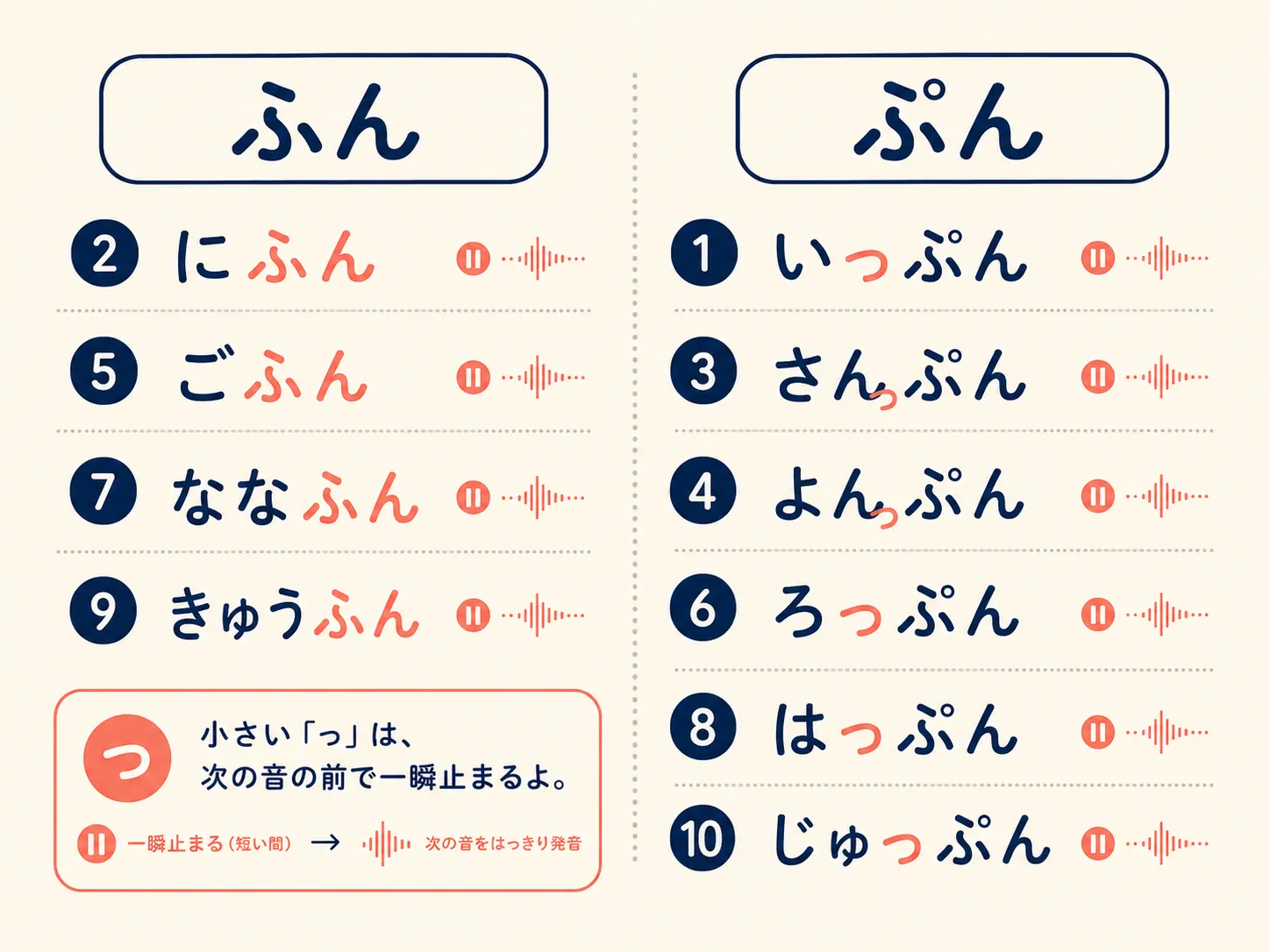
Minutes are the part learners need to practice aloud. The counter 分 changes between ふん (fun) and ぷん (pun), and several numbers also undergo a sound change.
| Minutes | Japanese | Reading |
|---|---|---|
| 1 minute | 一分 | いっぷん — ippun |
| 2 minutes | 二分 | にふん — nifun |
| 3 minutes | 三分 | さんぷん — sanpun |
| 4 minutes | 四分 | よんぷん — yonpun |
| 5 minutes | 五分 | ごふん — gofun |
| 6 minutes | 六分 | ろっぷん — roppun |
| 7 minutes | 七分 | ななふん — nanafun |
| 8 minutes | 八分 | はっぷん — happun |
| 9 minutes | 九分 | きゅうふん — kyūfun |
| 10 minutes | 十分 | じゅっぷん/じっぷん — juppun/jippun |
A practical memory pattern is:
- ふん: 2, 5, 7, 9
- ぷん: 1, 3, 4, 6, 8, 10
- Listen for the small っ in いっぷん, ろっぷん, はっぷん, じゅっぷん. It creates a brief pause before the p sound.
For larger numbers, check the final digit:
- 21 minutes: 二十一分(にじゅういっぷん)
- 34 minutes: 三十四分(さんじゅうよんぷん)
- 46 minutes: 四十六分(よんじゅうろっぷん)
- 59 minutes: 五十九分(ごじゅうきゅうふん)
You may hear 八分 as はちふん as well as はっぷん, and both じゅっぷん and じっぷん occur for ten minutes. For a beginner, はっぷん and じゅっぷん are reliable forms to learn first.
Putting Hours and Minutes Together
Say the hour first, then the minutes. Nothing goes between them.
| Time | Japanese | Reading |
|---|---|---|
| 5:05 | 五時五分 | ごじ ごふん — goji gofun |
| 6:18 | 六時十八分 | ろくじ じゅうはっぷん — rokuji jūhappun |
| 7:23 | 七時二十三分 | しちじ にじゅうさんぷん — shichiji nijūsanpun |
| 8:50 | 八時五十分 | はちじ ごじゅっぷん — hachiji gojuppun |
| 12:35 | 十二時三十五分 | じゅうにじ さんじゅうごふん — jūniji sanjūgofun |
Japanese often writes times with Arabic numerals—7時23分—even when the words are read in Japanese. This is what you are likely to see in messages, shop notices, schedules, and travel information.
Half past: 半 (はん)
Use 半 (はん, han) after the hour for “half past.”
六時半です。
ろくじはんです。
Rokuji han desu.
It is 6:30.
Both 六時半 and 六時三十分 are correct, but the shorter form is very common in conversation.
Quarter past and minutes to
Japanese has no special clock expression equivalent to English “quarter past.” Say fifteen minutes:
4:15 = 四時十五分(よじ じゅうごふん)
You can give a “minutes before” reading with 前 (まえ):
8:55 = 九時五分前(くじ ごふんまえ)
five minutes before nine
In ordinary conversation, 八時五十五分 is just as clear and is often easier for learners to produce.
AM, PM, Noon, and Midnight
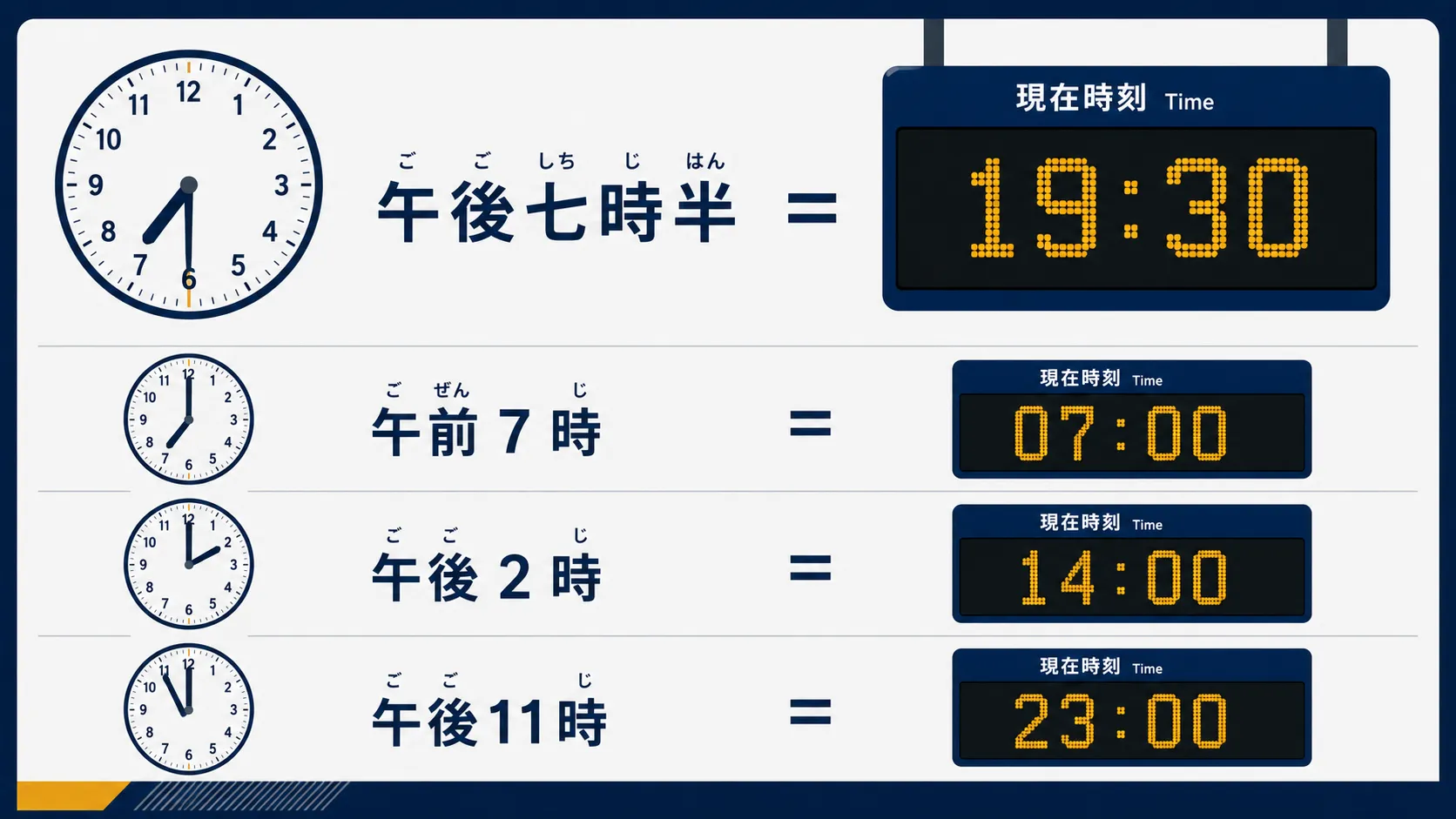
Put 午前 (ごぜん, gozen) or 午後 (ごご, gogo) before the time.
| Expression | Meaning | Example |
|---|---|---|
| 午前 | a.m. | 午前七時 — 7:00 a.m. |
| 午後 | p.m. | 午後三時半 — 3:30 p.m. |
| 正午(しょうご) | noon | 正午に会いましょう — Let's meet at noon. |
| 深夜(しんや) | late at night | 深夜一時 — 1:00 late at night |
| 午前零時/午前0時 | midnight | 午前0時に始まります — It starts at midnight. |
The order matters: Japanese says 午前九時, literally “a.m. nine o'clock,” not 九時午前.
The 24-hour clock is common in train schedules, business hours, event listings, hospitals, and formal written information:
- 14:00 = 十四時(じゅうよじ)
- 19:30 = 十九時三十分(じゅうくじ さんじゅっぷん)
- 23:45 = 二十三時四十五分(にじゅうさんじ よんじゅうごふん)
Late-night businesses and media schedules may use times beyond 24:00. 25:00 means 1:00 a.m. on the following calendar day while treating it as part of the previous night's schedule.
How to Ask “What Time Is It?” in Japanese
The most useful question is:
今、何時ですか。
いま、なんじですか。
Ima, nanji desu ka?
What time is it now?
To ask a stranger politely, begin with すみません:
すみません、今何時ですか。
Sumimasen, ima nanji desu ka?
Excuse me, what time is it now?
The answer follows the same formula:
三時二十分です。
Sanji nijuppun desu.
It is 3:20.
Friends may shorten the exchange:
A: 今何時? — What time is it?
B: もう七時半。 — It's already 7:30.
Asking what time something happens
会議は何時ですか。
Kaigi wa nanji desu ka?
What time is the meeting?
次の電車は何時に出ますか。
Tsugi no densha wa nanji ni demasu ka?
What time does the next train leave?
何時に集合しますか。
Nanji ni shūgō shimasu ka?
What time are we meeting?
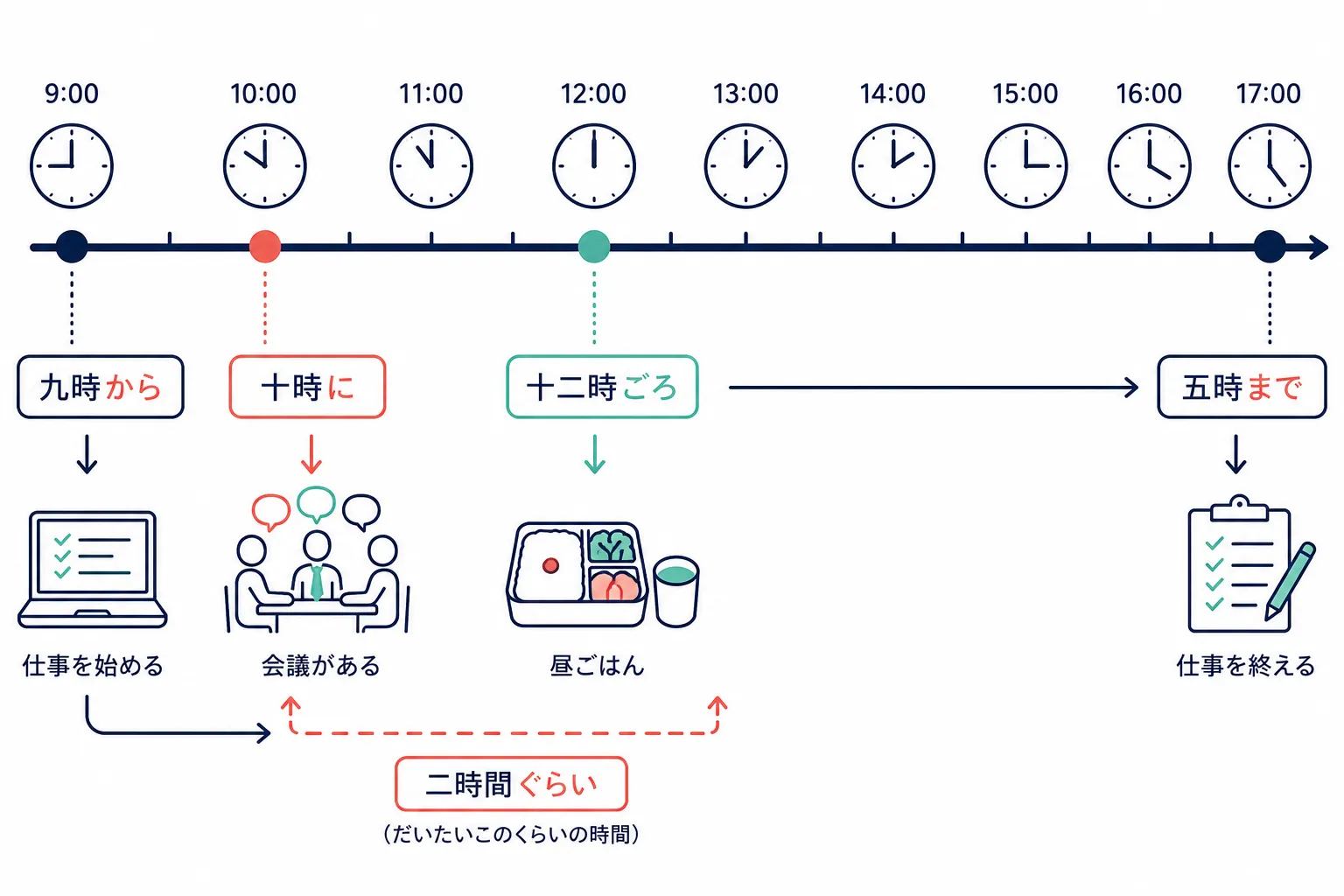
The particle に marks the time when an action occurs:
- 会議は三時です。 — The meeting is at three.
- 会議は三時に始まります。 — The meeting starts at three.
With です, the time can identify the schedule directly. With an action verb such as 始まります, 出ます, or 起きます, に marks when it happens.
Clock Time vs. Duration: 時 and 時間
This distinction prevents a major misunderstanding:
- 三時(さんじ) = three o'clock
- 三時間(さんじかん) = three hours
時 identifies a position on the clock. 時間 counts a duration.
| Japanese | Meaning |
|---|---|
| 一時に始めます。 | We will start at one o'clock. |
| 一時間勉強します。 | I will study for one hour. |
| 東京まで二時間かかります。 | It takes two hours to Tokyo. |
| 毎日八時間働きます。 | I work eight hours every day. |
Duration has its own reading choices. Four hours is 四時間(よじかん), while seven hours is commonly 七時間(ななじかん). Do not copy every clock-hour reading into duration expressions.
To ask about duration, use 何時間 (なんじかん):
大阪まで何時間かかりますか。
Ōsaka made nanjikan kakarimasu ka?
How many hours does it take to Osaka?
Useful Grammar for Schedules
に: at a specific time
毎朝六時に起きます。
Maiasa rokuji ni okimasu.
I wake up at six every morning.
Relative words such as 今日 (today), 明日 (tomorrow), and 毎日 (every day) normally do not take に in basic sentences.
から and まで: from and until
図書館は九時から五時までです。
Toshokan wa kuji kara goji made desu.
The library is open from nine to five.
ごろ: around
七時ごろ帰ります。
Shichiji goro kaerimasu.
I will return around seven.
Use ごろ for an approximate point in time. For an approximate duration, ぐらい/くらい is more natural:
二時間ぐらいかかります。
It takes about two hours.
前 and 後: before and after
- 十分前 — ten minutes before / ten minutes ago, depending on context
- 十分後 — ten minutes later
- 会議の十分前 — ten minutes before the meeting
- 三時から十分後 — ten minutes after three
Real-Life Conversations
At a train station
A: すみません、京都行きの電車は何時に出ますか。
Excuse me, what time does the train for Kyoto leave?
B: 十時十二分に出ます。
It leaves at 10:12.
A: 何番線ですか。
Which platform is it?
B: 三番線です。
Platform three.
Making a restaurant reservation
A: 今日の午後七時に、二人で予約できますか。
Can I make a reservation for two at 7:00 p.m. today?
B: はい、七時半なら空いています。
Yes, we have availability at 7:30.
A: では、七時半にお願いします。
Then 7:30, please.
Confirming an appointment
A: 明日のレッスンは何時からですか。
What time does tomorrow's lesson start?
B: 午前十一時からです。
It starts at 11:00 a.m.
A: わかりました。十分前に行きます。
Understood. I'll arrive ten minutes early.
Talking about opening hours
営業時間は午前十時から午後八時までです。
Eigyō jikan wa gozen jūji kara gogo hachiji made desu.
Business hours are from 10:00 a.m. to 8:00 p.m.
営業時間(えいぎょうじかん) appears frequently on store signs and websites. 受付時間(うけつけじかん) means reception or service-desk hours.
Essential Japanese Time Vocabulary
| Japanese | Reading | Meaning |
|---|---|---|
| 今 | いま — ima | now |
| 時間 | じかん — jikan | time; duration; hours |
| 時刻 | じこく — jikoku | a specific clock time |
| 時計 | とけい — tokei | clock; watch |
| 朝 | あさ — asa | morning |
| 昼 | ひる — hiru | daytime; noon period |
| 夕方 | ゆうがた — yūgata | early evening |
| 夜 | よる — yoru | night |
| 早朝 | そうちょう — sōchō | early morning |
| 深夜 | しんや — shinya | late night |
| 正午 | しょうご — shōgo | noon |
| 先ほど | さきほど — sakihodo | a short while ago |
| もうすぐ | mō sugu | soon; almost |
| ちょうど | chōdo | exactly |
| 遅刻 | ちこく — chikoku | lateness; being late |
“Time” is not always 時間
- 時間がありません。 — I do not have time.
- 出発時刻を確認します。 — I will check the departure time.
- 時計を見ます。 — I look at the clock/watch.
- 何時ですか。 — What time is it?
English uses one word for several ideas. Japanese chooses the noun that matches the meaning, so translating “time” as 時間 in every sentence produces unnatural Japanese.
Common Mistakes to Avoid
1. Reading every number the same way
Say よじ, しちじ, and くじ for 4:00, 7:00, and 9:00. For minutes, learn the complete sound unit—いっぷん—instead of mentally joining いち + ふん.
2. Confusing 三時 with 三時間
三時 is a clock time; 三時間 is a duration. The extra 間 changes “three o'clock” into “three hours.”
3. Putting AM or PM after the hour
Say 午後三時, not 三時午後. Japanese places 午前/午後 before the clock time.
4. Adding に everywhere
Use に with a specific time and an action: 七時に起きます. Do not attach it automatically to every time word: 明日行きます is natural without に.
5. Using ごろ for duration
七時ごろ means around seven o'clock. 七時間ぐらい means about seven hours.
6. Trusting romaji more than Japanese script
Romanization may show long vowels as jū, juu, or ju, and ten minutes as juppun or jippun. Learn the kana and kanji so spelling variation does not become a pronunciation problem.
Practice: Can You Read These Times?
1. How do you say 4:08?
四時八分(よじ はっぷん) — yoji happun
2. How do you say 7:30 a.m.?
午前七時半(ごぜん しちじはん) — gozen shichiji han
3. How do you say 9:46 p.m.?
午後九時四十六分(ごご くじ よんじゅうろっぷん) — gogo kuji yonjūroppun
4. How do you say "The meeting starts at 2:15"?
会議は二時十五分に始まります。
Kaigi wa niji jūgofun ni hajimarimasu.
5. How do you say "It takes about three hours"?
三時間ぐらいかかります。
Sanjikan gurai kakarimasu.
Frequently Asked Questions
What is the Japanese word for time?
時間 (じかん) means time or duration, 時刻 (じこく) means a specific clock time, and 時 (じ) is the counter used for “o'clock.”
How do you ask what time it is in Japanese?
Say 今何時ですか (いま なんじですか). Add すみません at the beginning when politely asking a stranger.
How do you say 4:00, 7:00, and 9:00?
They are 四時(よじ), 七時(しちじ), and 九時(くじ). These fixed readings should be memorized.
Why is 分 sometimes fun and sometimes pun?
Japanese counters change sound to make pronunciation flow naturally. Minutes ending in 2, 5, 7, and 9 generally use ふん; 1, 3, 4, 6, 8, and 10 use ぷん, with changes such as いっぷん and ろっぷん.
How do you say 30 minutes past the hour?
Add 半 (はん) to the hour. For example, 2:30 is 二時半(にじはん).
Does Japanese use a 24-hour clock?
Yes. It is especially common in written timetables, transport information, business hours, and formal schedules. Conversation often uses the 12-hour clock with context or 午前/午後.
What does 25:00 mean in Japan?
In late-night schedules, 25:00 means 1:00 a.m. on the following calendar day. The extended format keeps post-midnight activity grouped with the previous evening.
A Simple System to Remember
- Choose 午前/午後 if the part of day is needed.
- Say the hour with 時, remembering よじ・しちじ・くじ.
- Add minutes with 分, checking the ふん/ぷん sound.
- Use に when an action happens at that specific time.
- Use 時間 instead of 時 when you mean duration.
Once the hour exceptions and ten minute readings become automatic, the rest is assembly rather than guesswork. Practice with real train departures, calendar events, and opening hours: those are the situations where Japanese clock language becomes useful—and memorable.